
The Forteresse
Infrastructure
Construction
Work began in May 1935 on the schist spur of TANCREMONT at an altitude of 302 m. The Fort of PEPINSTER began to take shape. It was inaugurated on 8 August 1937. Fort Code – HSW ) is starting to take shape.
It was inaugurated on August 8, 1937.
This future Battery is part of the LIEGE Fortress Regiment ( HSW/IV/RFL ), under the command of the III Corps ( III AC ).
The military area.
The military terrain extends over 45 Ha. The structure consists of a central massif with an area of 3.30 Ha, including the combat buildings. A moat (1.20 Ha) surrounds the massif and is defended by four armed flanking chests.
The Fort cost BF 80,000,000 in 1940, or €2.160 billion.
The site is still part of the Defence , and access to it is still prohibited outside our openings. Flyover with drone is it strictly forbidden!!! (With reference to the Criminal Code Art 120ter§2, Art 534, AR 1 of 06/12/1897)
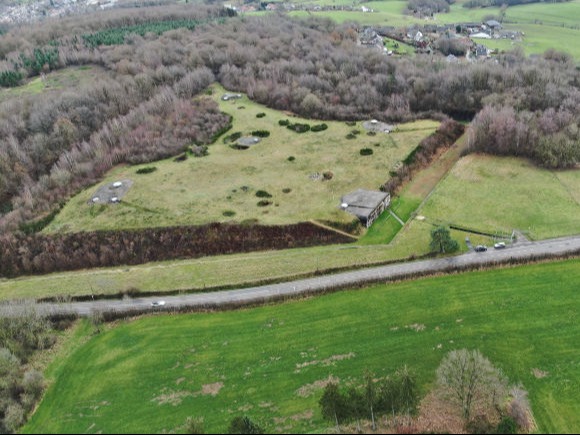
The underground barracks consist of:
– nine independent battle blocks,
– a command post, (PC)
– technical rooms,
– from the barracks: kitchen, rooms and hospital.
– of two air intake blocks, ventilation is provided by the chimney of block P or O, at a rate of 32000 M3/h,
– All the blocks are connected by galleries over a total distance of 2500 m to a depth of between 20 and 27 m, in addition to the 1411 steps.
– 900 light points are required for lighting the infrastructure.
Combat vessels shall comprise:
– the entrance block (BI) with a Mi bell,
– two blocks (BII and BIV) with a dome of two C75s, and protected by two Mi bells.
– block (BIII) with three MG-turrets,
– the mortar block (BM)
– armed safes (CI, CII/III, CIV), prohibiting access to the ditch.
– Outside the massif, block P is access in time of war, block O has no access. Both blocks are defended by an FM. These two blocks have the particularity of having an air intake chimney for constant overpressure in the structure.
– the anti-tank casemates (VESDRE, MONT) are on the periphery and are armed with a 4.7 and an FM.
– There are 16 OPs, or observation posts, located in the operational area of the fort.

Its armament
– 2 X 2 75 mm FRC guns (C75) under dome,
– 3 mortars of 81 mm fortress, STOKES-BRANDT
– 4 47 mm FRC guns, known as ‘ 4.7 ’,
– 34 machine guns MG 8-15, Cal 7.65 (Mi), including 8 anti-aircraft machine guns (MiCA)
– 7 machine guns FN, Cal 7.65 (FM)
– Mauser FN 1889/16, GP35, PLF, grenades ‘ Mills »
The barracks, the hospital and the technical rooms
The fort is powered by 4 130 hp CARELS generators, with 7 tanks of 2 M3 of oil.
A radio room with an ERM-SBR and RADIO BELL transceiver.
The barracks consist of rooms, a canteen, a kitchen, showers, a washroom, but also a hospital, treatment room, pharmacy...
Living reserves are stored for 600 people for a period of one month.

The garrison
In May 1940, the staff consisted of:
– 15 Officers, including a surgeon, two doctors and a chaplain.
– 54 Non-commissioned officers,
– 412 Brigadiers and Soldiers,
– 9 reinforcements from the 3 Engineer Battalion (1 NCO, 8 Soldiers),
– 11 telegraph operators, (1 non-commissioned officer, 10 soldiers)
– 8 nurses.
– Seconded to LIEGE (EM-RFL): 1 Officer, 4 NCOs, 65 Soldiers.
The Holy Beard
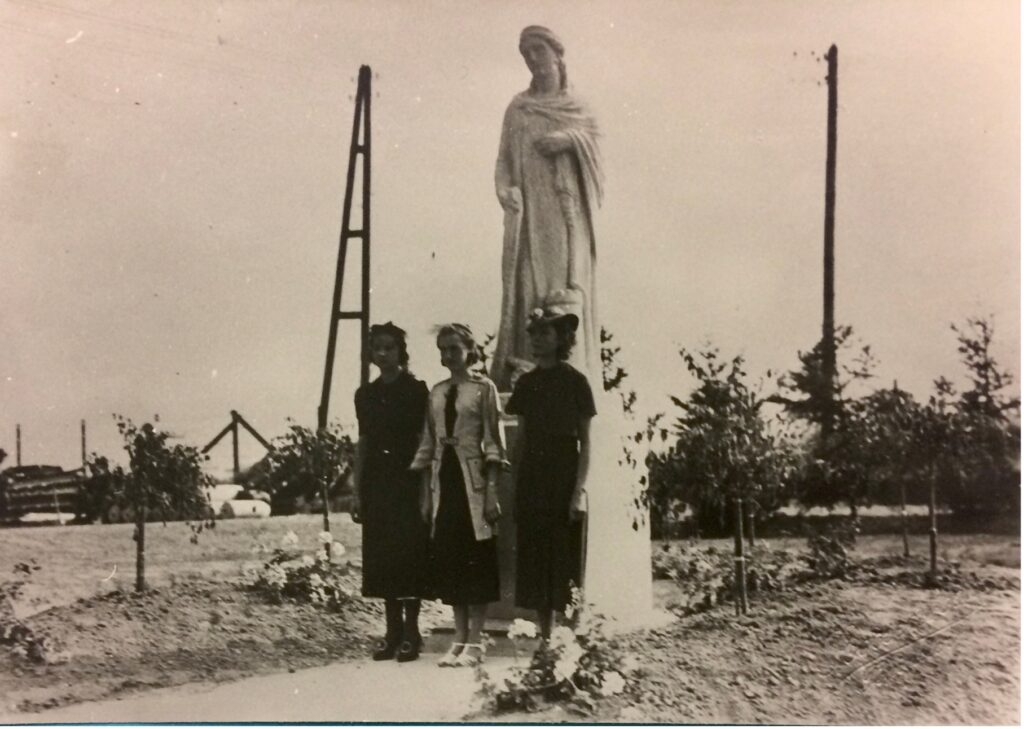
On August 8, 1937, the Patron of Gunners was inaugurated at the same time as the fort. (Photo opposite). It was donated to the Garrison by the 1914-1918 Veterans of PEPINSTER and THEUX.
It is erected on the access to the peacetime barracks.
At the end of the war, the Veterans moved it and installed it in the current location, on the edge of the N666, in order to facilitate access to it during ceremonies.